Tuesday, May 1, 2012

1st May, 2012: How do we use secant, chord, and tangent ratios in circles?

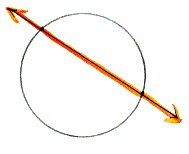
A secant in a circle is a straight line that intersects a curve at two or more points


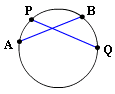
A chord is a line segment on the interior of a circle with both points lying on the circle


Two chords intersect inside a circle. Segment A X segment B= segment C X segment D

If two secant segments intersect outside a circle, then the product of the secant segment with it's external portion equals he product if the other secant segments with it's external portion.

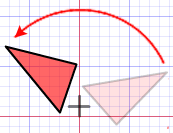
26th April, 2012: How do we review transformations?

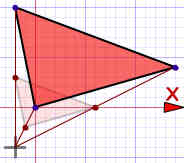
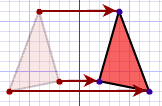
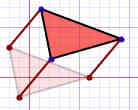
Isometry: Length is preserved, the figures are congruent

There are 4 types of transformations:
Rotation

Dilation

Reflection

Translation

24th April, 2012: What are altitudes, perpendicular bisectors, and angle bisectors?

Review:

An angle bisector bisects an angle in half, creating two congruent angles.

A perpendicular bisector is a line segment that bisects a line, and it's perpendicular to that line, creating a right angle.

An altitude is the height of the triangle.


23rd April, 2012: What are properties of medians and centroids?

Review:

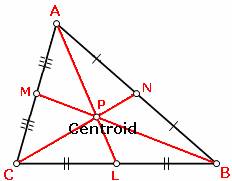
The median in a triangle is a line segment drawn from it's vertex (the very top) to the midpoint of it's opposite side. There are three medians in each triangle.


A centroid is the point of intersection of all its three medians.

19th April, 2012: How do we solve surface area and volume problems?

Review:
Area of a triangle: A= (BH/2) X2

Area of a kite: A= D1 (diagonal 1) X D2 (diagonal 2) /2


Given a semi-circle within a triangle, to find the area of the shaded region, you'd find the area of the triangle, area of the circle, then divide by two (since its a semi-circle). Then, you'd subtract the area of the circle from the triangle.

18th April, 2012: How do you find the surface area and volume of a sphere?

Spheres:

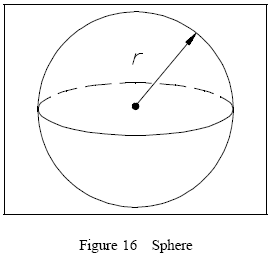
A sphere is the set of all points in space equidistant from a given point called the center.

You can find the surface area of a sphere by using the formula SA= 4πr².

Example: Given radius= 14inches
               SA= 4πr²
               SA= 4π(14)²
               SA= 784π
               SA= 2,463.0inches²

You can find the volume of a sphere by using the formula V= 4/3πr³.

Example: Given radius= 12meters
               V= 4/3πr³
               V= 4/3π(12)³
               V= 7,238.2meters³

15th March, 2012: How do we find the area of parallelograms, kites, and trapezoids?

Area of a parallelogram: B(ase) x H(eight)
Area of a trapezoid: (B1+B2/2)x H